
Self Adhesive Sticker Materials: A Complete Technical Guide
Self adhesive sticker materials — also called pressure-sensitive label stock or PSA materials — form the backbone of modern packaging, logistics, and brand communication. From a humble wine bottle to a complex pharmaceutical blister pack, the adhesive label is both information carrier and silent brand ambassador. Yet behind that thin, apparently simple strip lies a sophisticated multilayer composite engineered to perform across wildly different surfaces, environments, printing systems, and regulatory requirements.
Anatomy of a Self Adhesive Label Construction
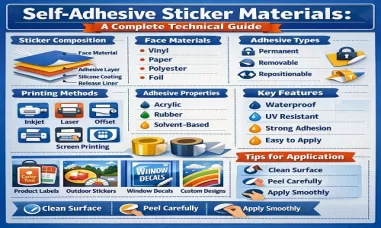
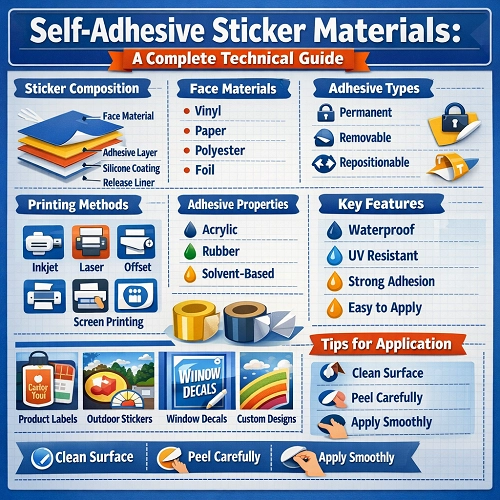
Every roll of self adhesive sticker material is a precision-engineered multilayer composite. Understanding each layer's role is essential when specifying materials for a particular application.
The Facestock (Surface Material)
The facestock — or face film — is the visible, printable layer of the label. It must balance competing requirements: printability, dimensional stability, conformability, and resistance to the environment it will face in the field. Facestock materials fall into two broad camps: paper-based and film-based. This guide focuses on film-based materials, which dominate demanding packaging applications.
The Print Coating
Most film facestocks receive a thin topcoat (typically 1–3 µm) that modifies surface energy, ink adhesion, and scratch resistance. Without this coating, standard inks bead off the non-polar surface of polypropylene or polyethylene. The coating type — aqueous, UV-curable, or solvent-based — determines which ink systems are compatible and what post-print treatments are feasible.
Pressure-Sensitive Adhesive (PSA)
The PSA is coated on the reverse of the facestock at typical coat weights of 15–50 g/m², depending on the target substrate and peel strength requirement. PSA formulations fall into three major chemistries: acrylic (water- or solvent-based, excellent UV resistance and transparency), rubber-based (higher initial tack, cost-effective but limited thermal resistance), and hotmelt (solvent-free, fast set, widely used in high-speed labeling). Each chemistry offers a different balance of initial tack, ultimate adhesion, shear resistance, and temperature stability.
Silicone Primer & Release Liner
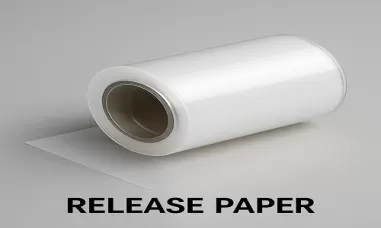
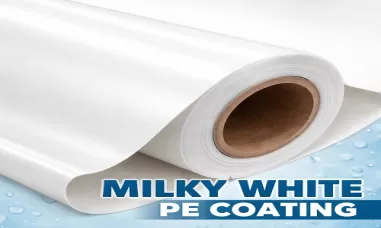
A thin primer layer anchors the silicone coating to the liner substrate, preventing silicone transfer to the adhesive. The release liner itself — either glassine, kraft paper, PET film, or PE-coated paper — provides the dimensional backbone for converting and dispensing. Liner release force is carefully calibrated: too high and labels won't peel smoothly on automatic dispensers; too low and the roll can delaminate in humid storage.
Industry Standard: Release Force Measurement
Release force is typically measured as grams-per-centimetre of width at a 180° peel angle and 300 mm/min peel speed per FINAT Test Method FTM 3. Standard classifications range from "easy release" (≈10–20 g/cm) to "high-tack liners" (>60 g/cm) for specialty applications.
Film Substrate Types & Technical Properties
WBL's Lightweight Film Series and Durable Film Series together cover a comprehensive matrix of polymer substrate options. The following table summarises the key technical characteristics of each major film type.
| Material | Density (g/cm³) | Typical Thickness | Tensile Strength | Clarity | Key Advantage |
|---|---|---|---|---|---|
| PP (Biaxially Oriented) | 0.90–0.91 | 40–80 µm | Medium–High | Excellent | Lightest film; "no-label look" |
| PET (Polyester) | 1.38–1.40 | 36–75 µm | Very High | Excellent | Dimensional stability; heat resistance |
| PE (Polyethylene) | 0.92–0.96 | 50–120 µm | Low–Medium | Hazy to clear | Flexibility; conformability on squeezable bottles |
| MDO-PE | 0.94–0.97 | 40–70 µm | Medium | Good | Monomaterial; recyclable with PE stream |
| PCR-PLA / Bio-based | 1.20–1.24 | 40–80 µm | Medium | Good–Excellent |
Polypropylene (PP) Films
Biaxially oriented polypropylene (BOPP) is the workhorse of the lightweight film label market. Its low density (0.90 g/cm³) means more label area per kilogram of raw material — a direct cost and sustainability benefit. BOPP offers outstanding clarity, enabling the popular "no-label look" on clear bottles, where the label appears to be printed directly on the container. The surface is naturally low-energy, requiring corona treatment and specialised print coatings to achieve adequate ink adhesion.
WBL's Lightweight Film Series offers PP in transparent, super-transparent, matte transparent, bright white, and matte white variants — covering both on-shelf aesthetics and functional printing requirements. The combination of balanced stiffness and flexibility makes PP ideal for high-speed automatic labeling lines where web tension consistency is critical.
Polyester (PET) Films
PET is the premier choice when dimensional stability, thermal resistance, and chemical resistance are paramount. Its very high tensile strength (typically 170–200 MPa in the machine direction) prevents label stretching during die-cutting and application, ensuring precise registration on automated lines. PET labels withstand continuous service temperatures up to ~150°C — essential for engine compartment labels, sterilizable medical labels, and hot-fill beverage applications.
Silver and laser (holographic) PET variants from WBL add a premium decorative dimension, widely used in wine, spirits, and cosmetics packaging where shelf differentiation drives purchasing decisions.
Polyethylene (PE) Films
PE films distinguish themselves through conformability — the ability to wrap around irregular, squeezable, or deeply contoured surfaces without lifting or wrinkling. This property is exploited in personal care labels (shampoo, conditioner), agricultural chemical containers, and flexible pouches. The lower stiffness that enables conformability also demands careful calibration of adhesive tack and dispensing tension on labeling machines.
Machine-Direction Oriented PE (MDO-PE)
MDO-PE represents a significant advance in sustainable label engineering. By orienting the polyethylene film in the machine direction only (rather than biaxially), manufacturers achieve a stiffness profile closer to BOPP while retaining the material identity of PE — crucial for the emerging monomaterial recyclability standard in European packaging legislation (EU Packaging and Packaging Waste Regulation, PPWR). MDO-PE labels can be recycled in the polyethylene waste stream alongside the flexible packaging they are applied to, eliminating a longstanding separation challenge.
PCR-PLA and Bio-Based Films
Post-consumer recycled (PCR) content films and polylactic acid (PLA) bio-based films address growing brand-owner sustainability commitments. PLA is derived from fermented plant starch (typically corn), is compostable under industrial conditions, and carries a lower embodied carbon footprint than petroleum-derived polymers. PCR content films incorporate recycled material — from post-consumer bottles or industrial scrap — into the facestock, reducing virgin resin demand without sacrificing label functionality.
Adhesive Chemistry & Performance Parameters
The adhesive layer is arguably the most performance-critical component of a self adhesive material — it is, literally, the mechanism that makes the label stay where it's placed. Modern PSA adhesives are characterised by three inter-related mechanical properties: tack, peel adhesion, and shear resistance.
- Initial Tack (Quick Stick) — The adhesive's ability to bond to a surface under light, brief pressure. Measured by loop tack or rolling ball tack. Critical for automatic high-speed labeling where dwell time is milliseconds.
- Peel Adhesion — The force required to remove a label at a defined angle (typically 90° or 180°) after a 20-minute dwell. Expressed in N/25mm. Dictates whether a label can be repositioned or becomes permanent.
- Shear Resistance (Cohesive Strength) — The adhesive's resistance to creep under sustained load parallel to the substrate surface. Poor shear leads to label slippage — a critical failure mode in hanging price tags, bookbinding, and structural bonding applications.
Acrylic PSA Systems
Water-based acrylic adhesives are the dominant choice for food-contact and general-purpose labels due to their excellent UV/ozone resistance, optical clarity, and wide service temperature range (-20°C to +120°C). Solvent-based acrylics offer higher cohesive strength but carry VOC emission and regulatory considerations. UV-cured acrylics are increasingly used in converter operations to eliminate solvent handling entirely.
Rubber-Based PSA Systems
Natural and synthetic rubber adhesives deliver exceptionally high initial tack — ideal for application to low-energy surfaces and in cold-temperature environments (cold-room labeling of frozen goods, refrigerated produce). Their Achilles heel is poor UV and ozone resistance, which limits outdoor durability to weeks rather than years. WBL's Durable Film Series addresses long-term outdoor applications with specifically formulated acrylic-based adhesives.
Hotmelt PSA Systems
Hotmelt adhesives are 100% solids systems — no water or solvent carrier — applied in molten form at elevated temperature. Their zero-VOC profile and rapid set make them the adhesive of choice in high-output converting operations. Performance has historically lagged behind solvent acrylics in thermal resistance, but advances in metallocene-catalysed polyolefin hotmelts have narrowed the gap significantly.
| Adhesive Type | Initial Tack | UV Resistance | Temp. Range | Food Safe | Typical Application |
|---|---|---|---|---|---|
| Water-Based Acrylic | Medium | Excellent | -20 to +120°C | Yes (grades) | Food, pharma, general packaging |
| Solvent-Based Acrylic | Medium–High | Excellent | -20 to +150°C | Restricted | Industrial, automotive, durable goods |
| Natural Rubber | Very High | Poor | -40 to +80°C | No | Cold-room, produce, short-life labels |
| Hotmelt | High | Medium | -20 to +100°C | Yes (grades) | |
| UV-Cured Acrylic | Medium | Excellent | -20 to +130°C | Yes (grades) | Premium cosmetics, electronics |
Printing Compatibility & Coating Technologies
The printability of a self adhesive sticker material depends on the interplay between the topcoat chemistry, surface energy, and the ink or toner system in use. WBL's film products are engineered with high-quality printing coatings that deliver excellent color reproduction across the broadest possible range of print technologies, supporting the industrial flexibility demanded by converters who may run multiple processes in a single facility.
Flexographic Printing
Flexography is the dominant narrow-web printing technology for self adhesive labels globally, accounting for over 55% of label print volume. Modern UV-flexo presses equipped with LED curing deliver excellent resolution (up to 175 lpi), fast cure, and low energy consumption. Film facestocks require coatings with a surface energy of 38–44 mN/m (measured post-corona treatment) for reliable ink adhesion without halo or fisheye defects.
Digital Inkjet & Laser (Dry Toner)
Digital print has disrupted the label industry with its ability to produce short runs, personalised labels, and variable data at zero setup cost. Inkjet systems — whether water-based, UV, or latex — demand coatings optimised for ink absorption and dot spread control. Dry toner (electrophotography) requires a coating that supports toner fusing temperatures without substrate deformation; PET's thermal stability makes it preferred here over PP for long-run laser applications. WBL's Variable Information Printing product line is engineered specifically for these digital-first workflows.
Thermal Transfer & Direct Thermal
Thermal transfer printing onto synthetic film labels is ubiquitous in logistics, healthcare, and warehouse management. A specialised topcoat receptive to wax, wax-resin, or full-resin ribbons is required. PET film is preferred for barcode durability in distribution environments. Direct thermal labels (no ribbon, heat-sensitive coating) are widely used for short-life shipping labels but are unsuitable for applications exposed to heat, friction, or prolonged UV exposure.
Industry Applications & Material Selection Guide
No single film or adhesive combination serves all markets. The following breakdown maps WBL product families to their optimal end-use industries, based on technical requirements from WBL's Lightweight Film Series and Durable Film Series product pages.
High-Speed Automatic Labeling: Performance Requirements
One of the defining technical challenges for self adhesive sticker materials is reliable performance on modern high-speed labeling lines that operate at 500–1,500 labels per minute. At these speeds, the material web must exhibit exceptional consistency in several dimensions.
Web Tension & Stiffness Balance
A facestock that is too limp (e.g., heavy PE without stiffeners) will flutter on the web, causing registration errors. Too stiff (e.g., thick PET) and it will resist conforming to curved surfaces after application. WBL's engineering focus on "lightweight surfaces with both stiffness and softness" reflects an optimal stiffness range — typically 50–150 mN for MD stiffness on 50µm PP — that threads this needle for the broadest labeling machine compatibility.
Dimensional Stability
Temperature and humidity fluctuations in a factory environment cause films to expand and contract. PET's very low thermal expansion coefficient (15–20 ppm/°C) makes it the preferred substrate for ultra-precise registration applications, while BOPP's higher coefficient requires careful tension control on the press.
Release Force Consistency
Liner release force must stay within tight tolerances across the entire roll — particularly between the start and end of a reel, where storage tension effects can alter the silicone release coating. WBL's PE Coated Paper and Silicon Paper Series provides the release liner substrates engineered to maintain this consistency across temperature and humidity ranges encountered in global supply chains.
Static Elimination
Film substrates — particularly PP and PET — are strong static generators. Static buildup attracts dust, causes labels to cling together, and can disrupt photocell sensors on automated dispensers. Antistatic coatings and in-line ionising bars are standard mitigations in both the converting process and on the label applicator.
Sustainability in Self Adhesive Materials
The label industry faces mounting pressure from brand owners, retailers, and regulators to reduce the environmental impact of packaging — and labels, while tiny relative to a bottle or carton, are a meaningful piece of that puzzle. Three sustainability trajectories are reshaping material selection.
Monomaterial Design
The most impactful change is the shift toward monomaterial label constructions that can be recycled without sorting complexity. MDO-PE film, combined with a PE liner and PE-compatible adhesive, creates an all-polyethylene label stack that can enter the flexible PE recycling stream intact. PET on PET liner constructions enable equivalent recyclability within the PET stream. WBL's product portfolio includes MDO options precisely to support these brand-owner sustainability roadmaps.
Liner Waste Reduction
Release liners account for approximately 30–35% of the total weight of a self adhesive label roll — and the vast majority is landfilled or incinerated after use. Industry initiatives such as linerless labels (labels applied without a release liner, using a non-stick topcoat instead) and liner recycling programs are gaining traction. WBL's Silicon Paper Series supports liner recyclability by enabling thinner liners with consistent release performance, reducing per-label liner waste.
PCR Content & Bio-Based Films
Incorporating post-consumer recycled (PCR) content into film facestocks closes the material loop on used plastic packaging. A 30–50% PCR-content PP or PET film retains sufficient optical and mechanical properties for most labeling applications while demonstrably reducing virgin polymer demand. WBL's inclusion of PCR-PLA in its surface material portfolio signals alignment with the brand-owner sustainability commitments becoming standard in FMCG, beauty, and food markets.
EU Packaging Regulation Context
The European Union's Packaging and Packaging Waste Regulation (PPWR), adopted in 2024, mandates minimum recycled content thresholds and recyclability targets for all packaging components by 2030. Self adhesive labels fall within scope. Specifiers sourcing from manufacturers with established MDO-PE and PCR film lines — such as WBL — are better positioned to meet these upcoming compliance requirements ahead of schedule.
Specifier's Quick-Reference Selection Guide
Use this decision framework to narrow film and adhesive selection for new applications:
| Requirement | Recommended Facestock | Recommended Adhesive | WBL Series |
|---|---|---|---|
| No-label look on clear bottles | BOPP Transparent | Clear acrylic, permanent | Lightweight Film |
| Premium wine / spirits | Laser / Silver PET | Acrylic, ice-bucket grade | Lightweight Film |
| Squeezable PE bottle | PE Film | Rubber-based or hotmelt | Lightweight Film |
| Engine bay / high temp | PET (75µm) | Solvent acrylic, +150°C | Durable Film |
| Frozen goods / cold-room | PP or PE | Rubber / low-temp acrylic | Lightweight Film |
| Barcode / variable data | PET (thermal transfer) | Permanent acrylic | Variable Info Printing |
| Recyclable monomaterial | MDO-PE | PE-compatible hotmelt | Lightweight Film |
| Compostable / bio-based | PCR-PLA | Compostable acrylic | Lightweight Film |